


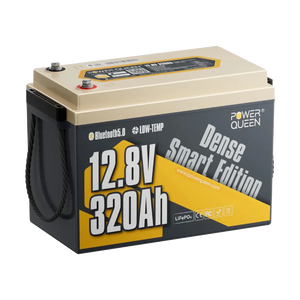







[2026] What Does A DC-DC Battery Charger Do
In this article, we will delve into the world of DC to DC chargers to provide you with a comprehensive understanding of their importance and functionality. Whether you have recently installed a dual battery system or are considering one, we will explore the necessity of DC to DC chargers. Stay tuned to discover the essentials of these chargers and determine if they are an essential component for your setup.
DC VS AC
DC (Direct Current) and AC (Alternating Current) are two different types of electrical currents commonly used in electrical systems.
DC refers to a steady flow of electric charge in one direction. It is typically produced by batteries, fuel cells, or solar cells. The voltage in a DC circuit remains constant, which makes it suitable for certain applications like electronics, automotive systems, and low-voltage devices. In RV systems, the batteries are mainly direct current.
On the other hand, AC refers to an electric current that periodically changes direction, typically at a frequency of 50 or 60 Hz. AC is generated by power stations and transmitted through power lines. AC voltage changes its polarity, resulting in a sinusoidal waveform. This alternating nature of AC current makes it suitable for long-distance power transmission and a wide range of household appliances.
Read More: What Is the Difference Between DC and AC?
What is A DC to DC Charger
A DC to DC charger is a device that converts the voltage from a DC power source (such as a battery, solar panel, or alternator) to a different voltage level that is suitable for charging another battery or device. It is commonly used in dual battery systems where one battery is charged by the vehicle's alternator (starting battery), and the other battery is used for auxiliary power needs (service battery). DC to DC chargers ensure a more efficient and controlled charging process, preventing overcharging and undercharging of batteries.
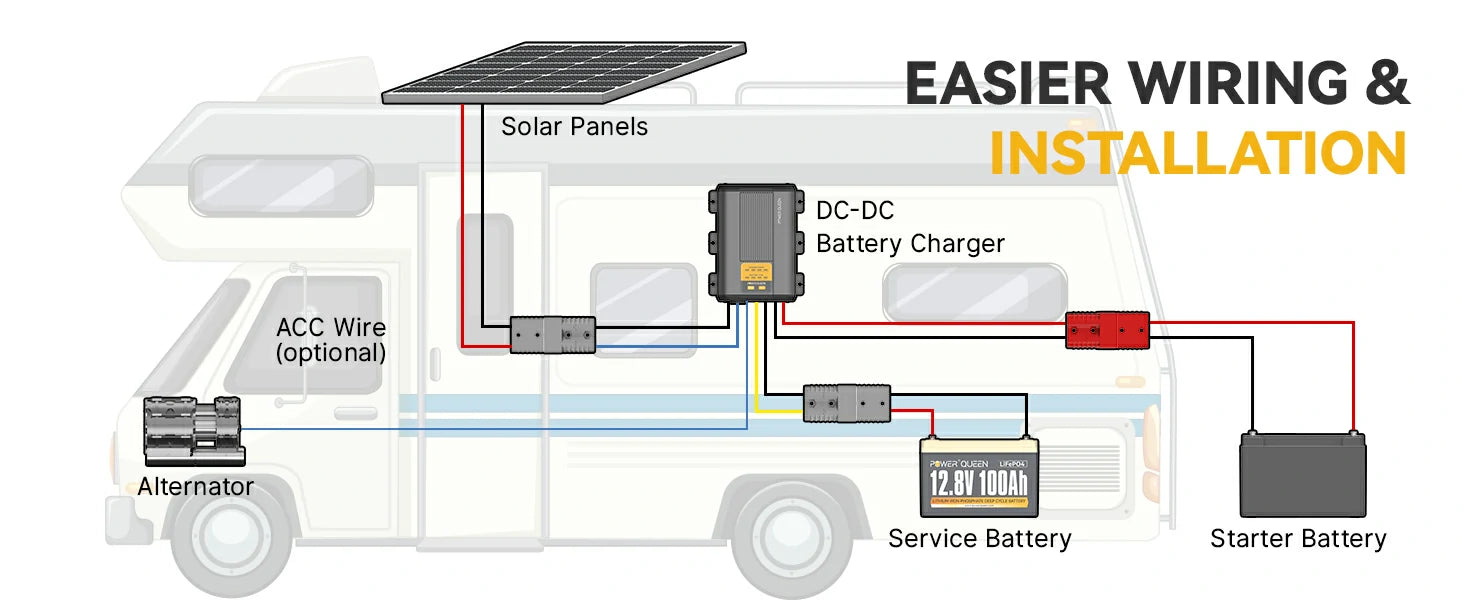
How Do DC to DC Chargers Work
DC to DC chargers, also known as DC converters or voltage regulators, work by converting the input DC voltage to a different output voltage level. They are commonly used to charge batteries or power different devices that require a specific voltage level.
Here is a general overview of how DC to DC chargers work:
- Input Voltage: The DC to DC charger receives a DC input voltage from a power source such as a vehicle's battery or a solar panel. The input voltage level generally needs to be higher than the desired output voltage.
- Regulation: The charger employs a regulation circuit to stabilize the input voltage and ensure a consistent output voltage. This circuitry may include components like capacitors, inductors, and transistors.
- Conversion: The regulated input voltage is then converted to the desired output voltage level using a voltage converter circuit. There are several types of voltage converter topologies used, including buck converters, boost converters, and buck-boost converters.
- Filtering and Regulation: After the conversion, the charger employs filtering techniques, such as using capacitors and inductors, to smooth out the output voltage and reduce any unwanted noise or fluctuations.
- Output: The regulated and filtered DC voltage is then supplied to the device or battery being charged. The charger continuously monitors the output voltage to ensure it stays within the desired range.
Overall, the main purpose of a DC to DC charger is to efficiently convert an input DC voltage to the desired output voltage, while providing stable and regulated power to the connected device or battery.
DC to DC Charger vs. Battery Isolator: Key Differences
When setting up a dual battery system, many owners are torn between a traditional Battery Isolator and a modern DC to DC Battery Charger. While both aim to keep your auxiliary battery charged, they operate on entirely different levels of technology.
The Traditional Choice: Battery Isolator
A battery isolator is essentially a high-current switch (relay). When your engine is running and the starter battery reaches a certain voltage, the isolator closes, connecting the alternator directly to your house battery.
- How it works: It acts as a bridge, allowing the alternator to charge both batteries simultaneously at the same voltage.
- The Downside: It cannot regulate voltage or current. It simply passes along whatever the alternator is outputting. For modern LiFePO4 batteries, this lack of control can lead to incomplete charging (often stuck at 80%) or even reduced battery life.
The Modern Standard: DC to DC Charger
A DC to DC charger is a sophisticated power converter. It takes the output from the alternator and "re-processes" it into a controlled, multi-stage charge tailored for your specific battery type.
- Voltage Boosting: Unlike an isolator, a DC to DC charger can "boost" low alternator voltage to the 14.4V–14.6V required to 100% charge a Lithium battery.
- Smart Alternator Compatibility: Most vehicles made after 2015 use smart alternators that drop voltage to save fuel. An isolator will often shut off or fail to charge in these cases, whereas a DC to DC charger remains active.
- Battery Protection: By regulating the current, it prevents your alternator from overheating and protects your lithium BMS from excessive initial surge currents.
| Feature | Battery Isolator | DC to DC Battery Charger |
|---|---|---|
| Charging Logic | Simple on/off connection | Multi-stage (Bulk, Abs, Float) |
| Voltage Control | None (Alternator dependent) | Precise (Boosts & Regulates) |
| LiFePO4 Compatible | Limited (Rarely hits 100%) | Perfect (Tailored profiles) |
| Smart Alternator | No (Often fails to charge) | Yes (Works seamlessly) |
Power Queen Expert Tip: If you are investing in a high-quality Lithium (LiFePO4) battery, a DC to DC charger is the best insurance policy. It ensures your house battery is charged safely and to its full capacity every time you drive.
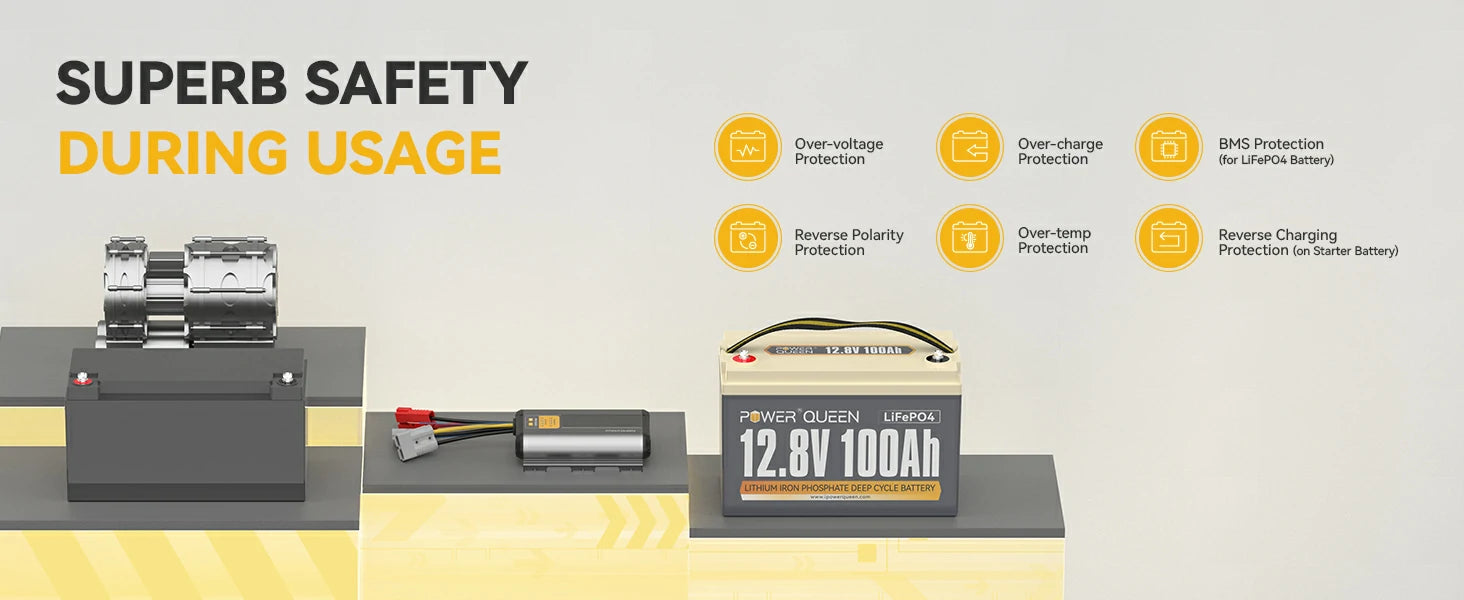
The Ultimate Solution: On-Board DC-DC Chargers with Solar Input
An On-Board DC-DC Charger is designed for permanent integration into your vehicle’s electrical system. Unlike portable chargers, it’s a set-and-forget solution that automatically manages power flow between your alternator, solar panels, and auxiliary batteries.
Why Choose a Dual-Input Model?
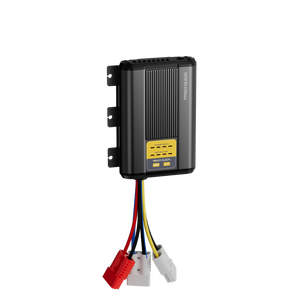
Modern off-grid setups often rely on both the engine's alternator and solar energy. A dual-input charger, such as the Power Queen 12V Dual Input DC-DC On-Board Charger, acts as the brain of your entire system:
- Smart Prioritization: It ensures your vehicle's starting battery is always prioritized, so you never get stranded.
- Simultaneous Charging: It can draw power from the alternator while driving and switch to (or combine with) solar power when parked.
- Simplified Wiring: By integrating a MPPT solar charge controller and a DC-DC converter into one "on-board" unit, you save space and reduce complex wiring in your RV or boat.
With a dual-input system, your LiFePO4 service battery stays charged whether you are cruising down the highway or camping under the sun. It eliminates the need for a separate solar controller, making it the most efficient way to stay off-grid for extended periods.
These chargers often feature multiple charging stages, such as bulk charging, absorption charging, and float charging, to maximize the battery's lifespan and maintain optimal performance. Some models also offer MPPT (Maximum Power Point Tracking) technology, which improves the conversion efficiency by finding the maximum power point of the solar panels to extract the most energy.
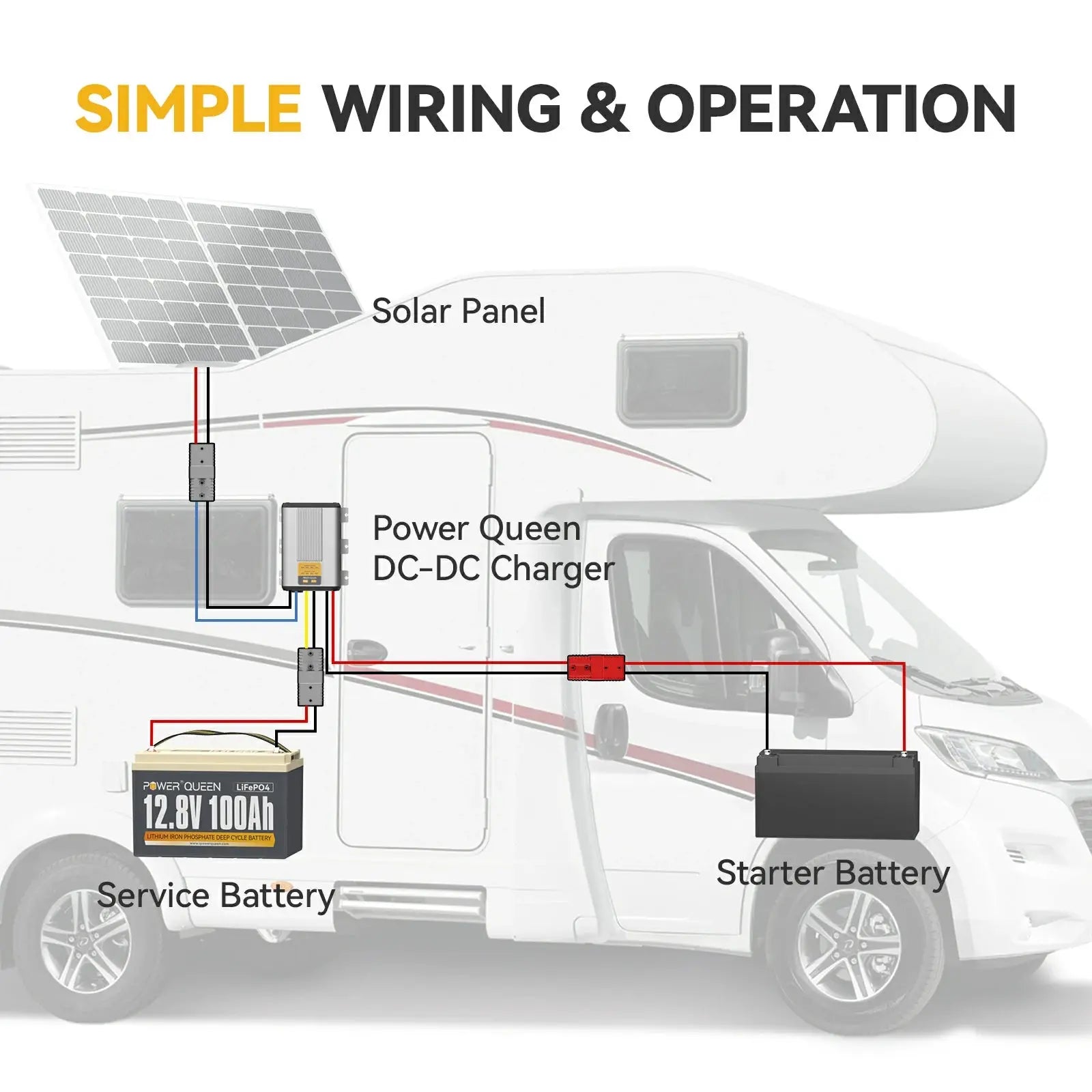
By using a DC to DC charger with solar input, you can utilize solar power to charge your batteries, reducing your reliance on the grid and providing a sustainable and renewable energy source for your charging needs.
What Size DC to DC Charger Do I Need?
Customers often ask us how to choose the right DC-DC Battery Charger based on their battery size. The answer is simple: for auxiliary batteries less than 100Ah, a 25A DC to DC charger is suitable regardless of the battery chemistry. However, for batteries over 100Ah, we recommend selecting the 40A model.

Is Dual Input DC TO DC Battery Charger Suitable for You?
If you've got solar panels on your RV or van and want to charge your house battery while driving, the Dual Input DC TO DC Battery Charger is perfect for you. It does the job of a battery isolator/charger and charge controller all in one, so you can replace your current charge controller.
It's also great if you need to charge an auxiliary battery that powers things like a fridge or tools in your van or truck. And even if you've got a Folding Solar Suitcase without a built-in charge controller, this charger can still juice up your battery effectively.
And here's the cool thing: if you live or travel in places with limited sunshine or during seasons when the sun isn't as bright, this charger gives you an extra boost in charging current from your alternator. So you can go on those extended boondocking adventures without worrying about adding more solar panels.
Bottom line, the Dual Input DC TO DC Battery Charger is a versatile and dependable solution. It lets you make the most of your solar panels and alternator, so you can efficiently charge your batteries in all kinds of situations.
You may also like
<<< What is a Battery Monitor and Why Do You Need It