








What Does an Inverter Do in an RV? (A Beginner's Guide to Selection)
Off-grid electricity is essential for outdoor camping and long-term RV travel, and the inverter is the core component of an RV off-grid power system. It directly affects the stability and convenience of electricity use outdoors.
Many beginners lack sufficient knowledge about inverter selection and installation. As a result, they often encounter problems such as choosing the wrong unit, overload tripping, or being unable to run high-power appliances.
This article explains inverter basics in a straightforward way, covering operating principles, product selection, and installation. It is designed to help beginners choose and use the right inverter and enjoy greater freedom when using electricity outdoors.
1. What Is an Inverter?
An inverter is a power conversion device that converts direct current, or DC, into alternating current, or AC, providing a suitable power supply for various AC-powered devices.
If you are confused about DC or AC, check out What Is the Difference Between DC and AC?
It is widely used in residential energy storage, RVs, boats, and other power supply applications. It is a key component in an energy storage system that connects the battery to household appliances.
2. What Does an Inverter Do in an RV?
The main function of an RV inverter is to convert the 12V DC power supplied by the battery into 120V household AC power, allowing it to power common appliances such as televisions, refrigerators, microwaves, and computers.
Simply put, an inverter is a core component for off-grid RV camping. Without it, all AC outlets in the RV will lose power once the vehicle is disconnected from campground shore power. Household appliances will no longer be usable, which greatly limits the off-grid travel experience.

3. How Does an RV Inverter Work?
The operating principle of an RV inverter is simple and straightforward. During operation, the inverter’s internal circuitry automatically steps up the DC voltage and converts it into AC power. The entire process requires no manual intervention, and the inverter is ready to use once it is powered on.
The maximum load the system can support is determined by both the inverter’s rated power and the battery’s discharge capability. The rated power determines the maximum wattage of the appliances the inverter can run, while the battery’s discharge capability determines the amount of current it can supply.
The system can operate properly only when these two factors are correctly matched.
4. How to Choose the Right Inverter Size for Your RV
4.1 Important Considerations Before Choosing an Inverter
Before choosing an inverter, be sure to confirm the voltage of your RV’s electrical system.
Most American RVs use 12V systems, but some large RVs or modified vehicles may use 24V or 48V systems. When selecting an inverter, make sure its input voltage exactly matches the vehicle’s system voltage. Inverters with different input voltages must not be used interchangeably.
4.2 Steps for Choosing the Right Inverter Wattage
First, calculate the running wattage and peak startup wattage of all AC appliances, paying particular attention to high-load devices such as air conditioners and microwaves.
Second, use the combined running wattage as the minimum rated power required for the inverter. An inverter selected according to this figure can operate normally, but care must be taken to avoid overloading it.
It is recommended to leave an additional 15% to 20% power margin to improve system stability.
4.3 Key Inverter Specifications You Need to Know
The three main technical specifications of an inverter directly determine its performance and the overall user experience. They can also help you quickly determine whether a unit is suitable for your needs.
| Technical Specification | Main Function |
|---|---|
| Rated Power | Determines the inverter’s long-term, stable load capacity. It is the main basis for product selection and must cover the total wattage of the appliances used on a daily basis. |
| Peak Power | Supports the momentary startup demand of high-power appliances such as air conditioners and microwaves, helping prevent tripping or startup failure. |
| Conversion Efficiency | Determines the proportion of energy lost during conversion. High-quality models can achieve an efficiency of more than 90%. The higher the efficiency, the longer the battery runtime. |

5. Pure Sine Wave vs. Modified Sine Wave Inverters
The main differences between the two common types of inverters are power quality, appliance compatibility, and suitable applications. The following table provides a clear comparison to help you choose the right type.
| Comparison | Pure Sine Wave Inverter | Modified Sine Wave Inverter |
|---|---|---|
| Output Waveform | Produces a clean and stable waveform that is consistent with utility grid power | Produces a stepped waveform with more electrical interference and greater fluctuations |
| Appliance Compatibility | Compatible with all household appliances, variable-frequency equipment, and precision instruments | Compatible with common devices such as lights, chargers, fans, refrigerators, and air conditioners |
| Effect on Appliances | Does not affect appliance performance | Long-term use may damage compressors and precision electronics |
| Suitable Applications | Long-term RV living and frequent off-grid camping; recommended | Short-term temporary camping and low-power applications |
Pure sine wave inverters are currently the mainstream choice for RV electrical upgrades. Their power quality is comparable to utility grid power, and they are compatible with various types of loads, making them suitable for long-term RV living.
Although modified sine wave inverters are less expensive, their power quality is limited. They are only suitable for short-term emergency use or purely resistive loads and are not recommended as the main inverter for daily use.
Read More: Everything You Need to Know about Pure Sine Wave Inverter.
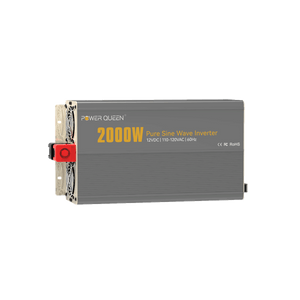
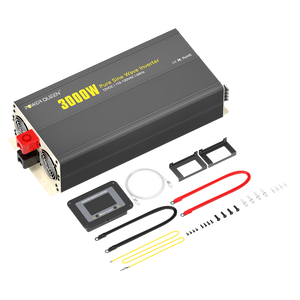
6. Recommended RV Inverters: POWER QUEEN 12V 2000W and 3000W Series
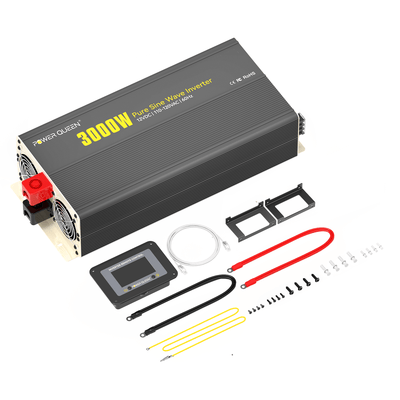
POWER QUEEN pure sine wave inverters are suitable for American RVs, camping, and off-grid power applications.
The series is available in 12V 2000W and 12V 3000W models, meeting the AC power needs of common appliances such as refrigerators, microwaves, and computers.

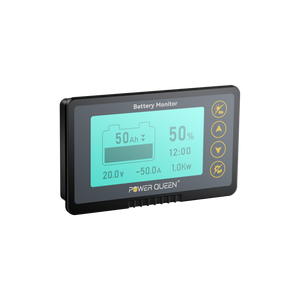
The inverters are equipped with a remote control display that allows users to view input status, output status, and fault information in real time. They also support remote on/off control, making them convenient for installation in RVs, trucks, and other locations with limited space.
With conversion efficiency of up to 90%, they effectively reduce energy loss and extend battery runtime.
They support peak power output of up to twice the rated power, allowing them to handle the startup demands of high-power loads with ease.
They also feature multiple built-in protection functions, including output overload protection, output short-circuit protection, over-temperature protection, high-voltage protection, and low-voltage protection, providing stable protection for RV power use.

7. How to Install an Inverter in an RV
Before installation, clean the installation area and make sure it is dry and well ventilated.
Secure the inverter in place and leave sufficient space for heat dissipation. Confirm that all power sources have been disconnected. Before wiring, make sure the inverter is switched off.
During wiring, connect the inverter’s positive terminal to the positive terminal of the battery and the negative terminal to the negative terminal of the battery.
Make sure the polarity is correct and do not reverse the connections.
Install a properly rated fuse or circuit breaker in the positive cable, and tighten all wiring terminals securely.
After completing the wiring, switch on the inverter. If a circuit breaker is installed, close the breaker first.
Connect a load and test whether the outlet is supplying power normally. If there are no error messages or unusual noises, the installation is complete.


8. Can an Inverter Power an Entire RV?
Yes.
By selecting an inverter based on the RV’s total load and allowing a 15% to 20% safety margin, a single inverter can reliably power all AC appliances in the RV when paired with a battery bank and solar system of sufficient capacity.
An inverter only converts electricity; it does not generate electricity. Running multiple high-power appliances at the same time will increase power consumption and drain the battery more quickly.
When several appliances need to be used, it is recommended to start them one at a time to avoid an instantaneous overload caused by multiple appliances starting simultaneously.
During daily use, solar panels can continuously recharge the batteries and extend operating time.
Most standard RVs do not require multiple inverters connected in parallel. One properly sized inverter is fully sufficient.
9. Frequently Asked Questions
FAQ 1: Is It Necessary to Install an Inverter in an RV?
Yes.
An inverter is a core component of an RV off-grid power system. Without it, all AC outlets inside the RV will be unusable once the vehicle is disconnected from shore power.
Most RV owners install an inverter as standard equipment, so it is recommended to include one directly in the electrical system configuration.
FAQ 2: Should I Choose a Factory-Installed Inverter or an Aftermarket Inverter for a New RV?
Factory-installed inverters generally offer only basic power capacity and functions.
If your electricity needs are low, the factory-installed inverter may be sufficient.
If you plan to use high-power appliances, an aftermarket inverter is recommended. This allows you to choose the appropriate power capacity and functions according to your needs and complete the upgrade in one step.
FAQ 3: Does an Inverter Consume a Lot of Power During Daily Use?
High-quality pure sine wave inverters have low no-load power consumption and high conversion efficiency, so their daily power consumption is highly manageable.
For example, the POWER QUEEN 12V 2000W inverter consumes only approximately 8W with no load, which has very little impact on battery runtime.
10. Conclusion
An RV inverter is the core component that enables off-grid electricity use in an RV. Its main function is to convert DC power into AC power, allowing household appliances to operate normally when shore power is unavailable.
Users only need to match the correct input voltage, select the appropriate inverter wattage according to the load, and give priority to a pure sine wave model.
POWER QUEEN RV inverters offer stable performance and intelligent energy-saving features, making them a cost-effective choice for upgrading an RV electrical system.