






The Ultimate Guide to Upgrading Yamaha Golf Cart Batteries
Upgrading Yamaha golf cart batteries to lithium can improve range, acceleration, charging speed, and everyday convenience. Most electric Yamaha Golf Carts need a battery that matches the cart’s voltage, controller demand, available space, charger, and regenerative braking system.
A lithium conversion is not only a battery swap. The battery, BMS, charger, cables, accessories, and motor controller must work together.
Understanding Yamaha Golf Cart Battery Systems
Most newer electric Yamaha Golf Carts use a 48V battery system, while some older models may use 36V. Always confirm the voltage through the vehicle label, charger, current battery configuration, or Yamaha’s official owner’s manual library.
| Existing Configuration | System Voltage |
|---|---|
| Six 6V batteries | 36V |
| Six 8V batteries | 48V |
| Four 12V batteries | 48V |
| One 51.2V LiFePO4 battery | Commonly sold as 48V |
A 51.2V LiFePO4 battery is commonly used in 48V golf carts, but voltage alone does not guarantee compatibility.

Why Upgrade Yamaha Golf Cart Batteries to Lithium
Lithium batteries provide steadier power, lower weight, faster charging, and almost no routine maintenance. They also deliver more usable capacity than traditional lead acid batteries.
Lead acid voltage gradually drops during use, which can reduce acceleration and hill climbing. LiFePO4 batteries maintain more stable voltage through most of the discharge cycle.
The U.S. Department of Energy notes that lithium ion batteries offer high energy efficiency, strong power to weight performance, and long service life. More technical background is available in the DOE electric vehicle battery guide.
| Feature | Lead Acid | LiFePO4 |
|---|---|---|
| Maintenance | Watering and cleaning | Minimal |
| Weight | Heavy | Much lighter |
| Charging speed | Slower | Faster |
| Power output | Drops during discharge | More consistent |
| Usable capacity | Lower | Higher |
| Upfront cost | Lower | Higher |
For example, a Yamaha cart used daily in The Villages, Florida may benefit more from faster charging and longer range than a cart used only for occasional golf.
Related Blog: Deep Cycle Redefined: Why Lithium is the Modern Alternative to Lead Acid.

How to Choose Batteries for Yamaha Golf Carts
The right battery must match voltage, current output, capacity, dimensions, and charging requirements. Amp hour capacity alone is not enough.
Confirm the Correct Voltage
A 48V Yamaha should use a battery designed for a 48V class system. Never choose a battery only by the cart’s appearance because similar Yamaha models may use different electrical systems.
Check BMS Current Output
The BMS must support normal driving and short periods of higher demand. Acceleration, hills, passengers, larger tires, and upgraded motors can all increase current draw.
A battery with an undersized BMS may shut down even when it still has stored energy.
Choose the Right Capacity
Capacity should match the distance, terrain, passenger load, and accessories used between charges.
| Battery Capacity | Best Use |
|---|---|
| 30Ah to 50Ah | Short trips and golf course use |
| 60Ah to 80Ah | Moderate neighborhood driving |
| 100Ah to 105Ah | Long routes, hills, and passengers |
| 150Ah or more | Commercial or high demand use |
A 100Ah battery is usually a better choice for owners who drive long community routes, carry passengers, or use the cart on hills.
Recommended Power Queen Battery for Yamaha Golf Carts
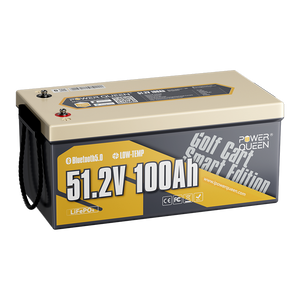
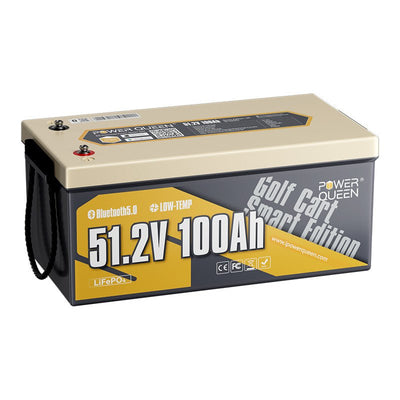
The Power Queen 48V 100Ah Smart LiFePO4 Battery is designed for higher demand 48V golf cart use. It provides 5,120Wh of energy, a 100A BMS, Bluetooth monitoring, and support for motors up to 5,000W.
Its dimensions are 20.47 by 10.59 by 8.66 inches, so owners should measure the battery compartment before ordering. Power Queen estimates approximately 40 to 47 miles of range under suitable conditions, although actual range depends on terrain, speed, load, and cart setup.
Bluetooth monitoring allows users to check state of charge, voltage, current, temperature, and battery condition from a phone. Full specifications are available on the Power Queen 48V 100Ah golf cart battery page.
Yamaha Golf Cart Compatibility Checks
A safe lithium upgrade requires checking more than voltage. Battery size, controller demand, regenerative braking, cables, charger, and accessories must all be reviewed.
Measure the Battery Compartment
The battery must fit with enough room for terminals, cables, brackets, and seat clearance. It should also be firmly secured inside the tray.
Check Regenerative Braking
Some Yamaha Golf Carts send energy back to the battery during braking. The lithium battery and BMS must be able to accept this charging current.
A fully charged battery may reject regenerative current, which can cause faults or affect braking behavior. This is especially important for carts used on steep roads in areas such as Arizona or Texas.
Inspect Cables and Accessories
Old or corroded cables can overheat under high current. Replace damaged cables and tighten terminals to the manufacturer’s recommended torque.
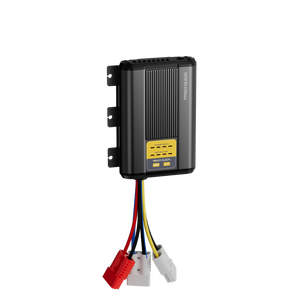
A 48V to 12V DC converter is normally required for lights, radios, USB ports, and other 12V accessories.
How to Upgrade Yamaha Golf Cart Batteries
A lithium conversion should follow both Yamaha and battery manufacturer instructions. Owners without electrical experience should use a qualified golf cart technician.
Document the Wiring
Photograph and label all cables before removing the original batteries. Record the main positive, main negative, charger, and accessory connections.
Remove the Lead Acid Batteries
Switch off the cart, disconnect the charger, and place the vehicle in the correct service mode. Follow the manufacturer’s disconnection sequence and use safe lifting methods.
Install the Lithium Battery
Place the battery in the tray, secure it with appropriate mounting hardware, and connect the cables using the correct polarity.
Install any required battery monitor, Bluetooth connection, DC converter, or state of charge display.
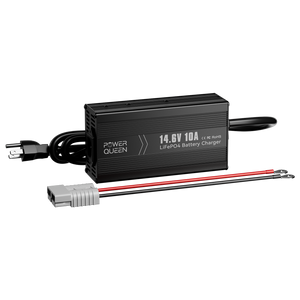
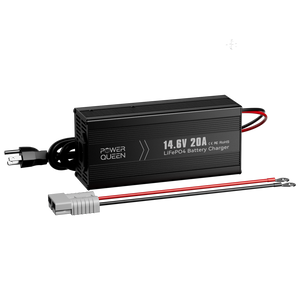
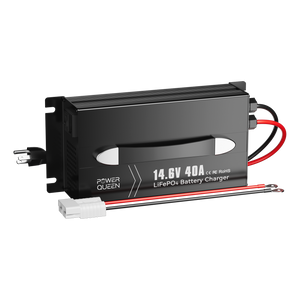
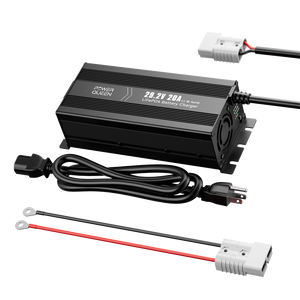
Use a Lithium Charger
A LiFePO4 battery should use a charger with the correct charging voltage and profile. The original lead acid charger should not be reused unless the battery manufacturer confirms compatibility.
Test at Low Speed
Test acceleration, braking, reverse, charging, and accessories on level ground. Stop if the battery disconnects, cables become warm, or warning lights appear.
Read More: Complete Guide: How to Convert a Golf Cart to Lithium Battery

Common Yamaha Golf Cart Battery Upgrade Mistakes
The most common mistake is choosing a battery only by voltage and capacity. BMS output, charger compatibility, physical size, and regenerative braking are equally important.
Another mistake is keeping the original lead acid charger. An incorrect charger may cause incomplete charging, BMS faults, or reduced battery life.
Owners should also replace the original battery gauge when necessary. Lead acid gauges often display lithium state of charge inaccurately.
Yamaha Lithium Conversion Cost
The total conversion cost may include more than the battery.
| Component | Purpose |
|---|---|
| LiFePO4 battery | Main energy storage |
| Lithium charger | Correct charging profile |
| Battery monitor | Accurate state of charge |
| DC converter | Powers 12V accessories |
| Mounting hardware | Secures the battery |
| Cables and labor | Supports safe installation |
Lithium costs more upfront, but lower maintenance, faster charging, and longer service life may improve long term value.
Maintaining Lithium Yamaha Golf Cart Batteries
Lithium batteries need little maintenance, but correct charging and storage still matter. Keep the terminals tight, the battery secured, and the case clean.
Do not charge below the battery’s permitted temperature unless it includes low temperature charging protection. During seasonal storage, follow the manufacturer’s recommended state of charge range.
FAQs About Yamaha Golf Cart Batteries
Are All Yamaha Golf Carts 48V?
No. Many newer Yamaha models use 48V systems, but some older carts may use 36V.
Can Six 8V Batteries Be Replaced With One Lithium Battery?
Yes, provided the lithium battery matches the voltage, current demand, charger, dimensions, and regenerative braking system.
Can I Use the Original Yamaha Charger?
Usually not. Use a charger approved for the selected LiFePO4 battery.
Will Lithium Make a Yamaha Golf Cart Faster?
Lithium may improve acceleration and maintain stronger performance, but it does not automatically increase top speed.
How Many Amp Hours Does a Yamaha Golf Cart Need?
A 30Ah to 50Ah battery may suit short trips, while a 100Ah battery is better for longer routes, hills, passengers, and accessories.
Does a Lithium Conversion Need a DC Converter?
Yes, if the cart uses 12V lights, radios, USB ports, or other accessories.
Final Thoughts on Yamaha Golf Cart Batteries
Upgrading Yamaha golf cart batteries to lithium can provide longer range, steadier power, lower weight, and easier maintenance. The key is choosing a battery that matches the cart’s voltage, controller, charger, available space, accessories, and regenerative braking system.
A properly planned conversion can make a Yamaha Golf Cart more reliable for golf, neighborhood travel, and property use.