









Group 27 vs Group 31 Battery Key Differences and How to Choose
Choosing the right battery for your vehicle or recreational setup often comes down to understanding specific classifications like Group 27 vs Group 31 Battery. These designations, standardized by the Battery Council International (BCI), indicate crucial differences in physical size, capacity, and performance that directly impact your power needs. This article will clarify these distinctions, helping you make an informed decision for your deep cycle battery requirements.
What Are BCI Battery Group Sizes
BCI Battery Group Sizes are a standardized classification system that defines a battery's physical dimensions, terminal configuration, and performance characteristics. This system, established by the Battery Council International (BCI), ensures consumers and manufacturers can identify compatible batteries across automotive, marine, and RV applications.
In practice, it simplifies replacement by ensuring the battery will fit correctly and connect properly.
What Is a Group 27 Battery
A Group 27 battery is a popular mid-sized option that balances compact dimensions with moderate energy storage. Typical dimensions are about 12.06" (L) × 6.81" (W) × 8.90" (H).
- Common uses: RVs, smaller boats, portable solar systems
- Best for: weekend trips and moderate power demands
💡 Read More: A Comprehensive Guide to Group 27 Deep Cycle Battery

What Is a Group 31 Battery
A Group 31 battery is a larger, higher-capacity alternative designed for heavier loads and longer runtime. Typical dimensions are about 13.00" (L) × 6.81" (W) × 9.44" (H).
- Common uses: large RVs, yachts, commercial trucks, off-grid systems
- Best for: consistent power delivery over extended periods
💡 Read More: Full Guide of Group 31 Battery , Dimension, Features and Recommendation

Differences Between Group 27 VS Group 31 Deep Cycle Battery
The key differences between Group 27 and Group 31 deep cycle batteries typically involve size, capacity, reserve runtime, weight, and starting power (CCA). Both can work well—what matters is matching the battery to your use case.
Physical Dimensions and Mounting Footprint
Group 31 batteries are larger and usually require more installation space.
- Group 27 (typical): 12.06 × 6.81 × 8.90 in (L × W × H)
- Group 31 (typical): 13.00 × 6.81 × 9.44 in (L × W × H)
The extra length (about 1") and height (about 0.5") can determine whether it fits your tray/compartment.
Energy Capacity and Reserve Runtime
In general, Group 31 provides higher capacity and longer reserve time.
- Capacity (lead-acid, typical range): Group 27 85–105 Ah vs Group 31 95–125 Ah
- Reserve capacity (RC, typical range): Group 27 140–200 min vs Group 31 150–220 min
If you run multiple appliances or want longer off-grid runtime, that extra reserve can matter.
Group 27 vs 31 Battery Weight and Portability
Group 31 is usually heavier due to its larger internal volume.
- Group 27 (lead-acid, typical range): 50–65 lb
- Group 31 (lead-acid, typical range): 60–75 lb
In multi-battery banks, the added weight can affect handling, payload, and balance.
Cold Cranking Amps and Starting Power
If cold starts matter, Group 31 often has higher CCA.
- Group 27 (typical range): 600–1,000 CCA
- Group 31 (typical range): 700–1,150 CCA
This can be especially beneficial for larger engines and cold-weather operation.
Comparison (typical lead-acid values):
| Feature | Group 27 Deep Cycle Battery | Group 31 Deep Cycle Battery |
|---|---|---|
| Typical Dimensions (L × W × H) | 12.06 × 6.81 × 8.90 inches | 13.00 × 6.81 × 9.44 inches |
| Capacity Range (Ah) | 85–105 Ah | 95–125 Ah |
| Reserve Capacity (RC) | 140–200 minutes | 150–220 minutes |
| Cold Cranking Amps (CCA) | 600–1,000 A | 700–1,150 A |
| Typical Weight (Lead-Acid) | 50–65 lb | 60–75 lb |
| Common Applications | Smaller RVs, fishing boats, moderate backup power | Large RVs, yachts, commercial trucks, heavy-duty backup |
If you’re looking for a quick comparison of Group 24, 27, and 31 dimensions, capacities, and applications, check out👉 Deep Cycle Battery Sizes Guide: BCI Group 24, 27 & 31 Size Chart.
How to Choose Between Group 27 and Group 31 Batteries
The right choice depends on your daily power usage, available space, and weight limits. There is no universal “best” option—only the best fit for your setup.
Assessing Your Daily Energy Consumption
Daily amp-hour (Ah) usage should drive your decision.
- Group 27 is often sufficient for lighter loads and short trips (lights, water pump, basic electronics).
- Group 31 is a better match for sustained loads and longer off-grid stays (fridge, inverter loads, multiple appliances).
Physical Compatibility and Fitting a Group 31 Battery in a Group 27 Tray
You may be able to fit a Group 31 battery in a Group 27 tray, but only after checking clearance. The width is often similar (about 6.81 inches), while Group 31 is typically longer and taller.
- Measure: tray length, compartment clearance, and hold-down compatibility
- Important: secure mounting to prevent movement and vibration damage
Evaluating Weight Limits for Marine and RV Applications
Weight matters for handling, trim, and payload limits. If you’re close to your RV’s GVWR or a boat’s balance limits, consider whether the added capacity is worth the added mass.
Upgrade to a Lithium Group 27 or 31 Battery for Better Performance
Switching to LiFePO4 lithium can improve weight, usable capacity, and cycle life compared to lead-acid.
Weight Reduction and Increased Energy Density
- Lithium Group 27 (typical): 24–30 lb
- Lithium Group 31 (typical): 27–35 lb
This is often close to half the weight of comparable lead-acid batteries.
Depth of Discharge and Usable Capacity Benefits
Lithium batteries can usually be discharged much deeper without damage, providing far more usable capacity. A 100Ah lithium battery can deliver close to 100Ah usable, while a 100Ah lead-acid battery is typically kept to about 50Ah usable to preserve lifespan.
Long Term Cost Efficiency and Cycle Life
Lithium costs more upfront but can be cheaper over time due to a much longer lifespan. Lithium can deliver 4,000 to 15,000+ cycles, while lead-acid is often around 300–500 cycles. It also charges faster and requires less maintenance.
| Feature | Lead-Acid Battery (Group 27/31) | Lithium (LiFePO4) Battery (Group 27/31) |
|---|---|---|
| Typical Weight | 50–75 lb | 24–35 lb |
| Usable Capacity | About 50% of rated Ah | Up to 100% of rated Ah |
| Cycle Life | 300–500 cycles | 4,000–15,000+ cycles |
| Maintenance | Regular (water levels, cleaning) | None |
| Charging Speed | Slower | Often 4–5× faster |
| Voltage Stability | Drops with discharge | Consistent throughout discharge |

Recommended Power Queen Lithium Options (Group 27 & Group 31)
If you’re considering a lithium upgrade, Power Queen offers two popular form factors that map directly to the sizes discussed above. Both options deliver the key lithium benefits—higher usable capacity, lighter weight, and longer cycle life—while keeping installation practical.
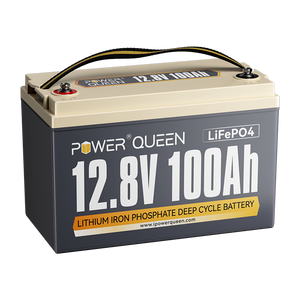
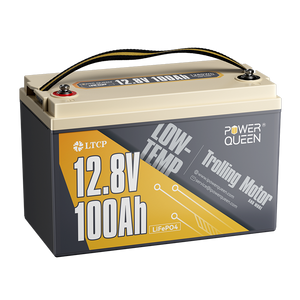
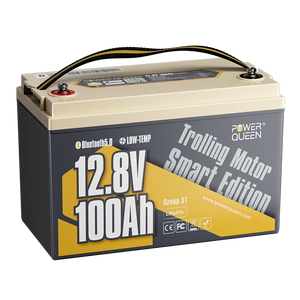
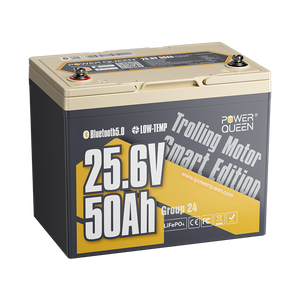
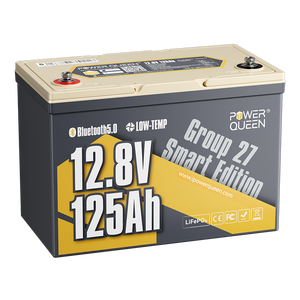
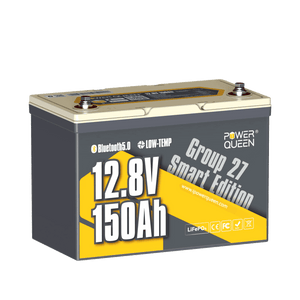
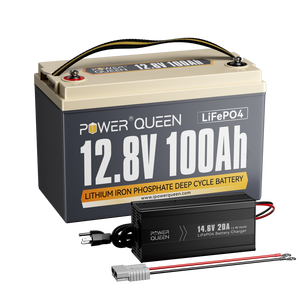
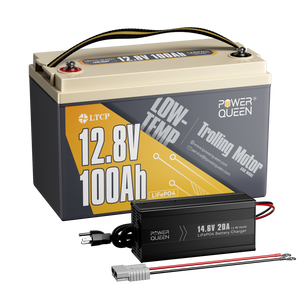
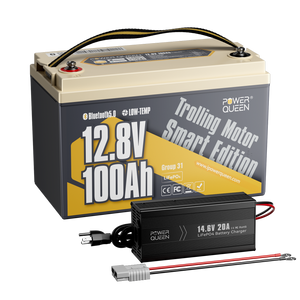
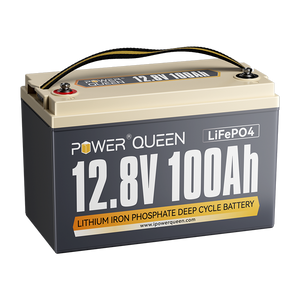
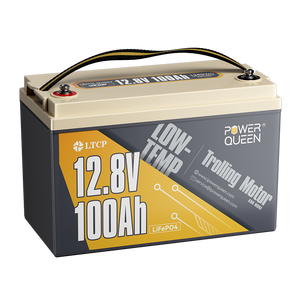
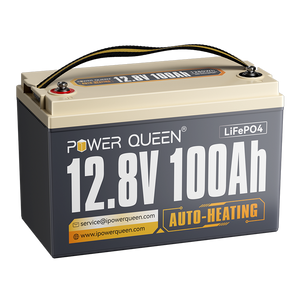
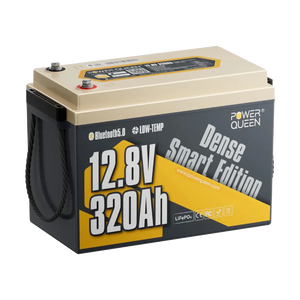
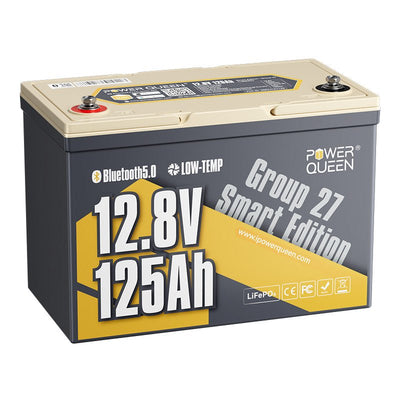
For a drop-in Group 27 fit with more runtime, choose the Power Queen 12V 125Ah Group27 Smart Deep Cycle Lithium Battery. If you prefer a true Group 31 footprint with system expandability, choose the Power Queen 12V 100Ah Group 31 Deep Cycle Lithium Battery.
| Specification | Power Queen 12V 125Ah Group27 Smart Deep Cycle Lithium Battery | Power Queen 12V 100Ah Group 31 Deep Cycle Lithium Battery |
|---|---|---|
| Capacity | 12V 125Ah | 12V 100Ah |
| Weight | 25.12 lbs | 24.25 lbs |
| Size | 12.13 × 6.69 × 8.31 in (Group 27 size) | 13.00 × 6.77 × 8.43 in (Group 31 size) |
| Energy | 1600Wh | 1280Wh |
| Bluetooth Function | ✔ (Bluetooth 5.0 monitoring + remote control) | — |
| Low Temp Protection | ✔ (Charge cut-off < 32°F; Discharge cut-off < -4°F) | — |
| Max. Continuous Output Power | 1280W | 1280W |
| Cycle Life | Up to 15,000 cycles | 4000+ cycles @100% DOD; 8000+ cycles @80% DOD; up to 15,000+ cycles @60% DOD |
Note: Some specifications are not provided for both models (shown as “—”). Values may vary by version and test conditions.
FAQs about Group 27 VS Group 31 Battery
Can I mix Group 27 and Group 31 batteries in a parallel bank?
Mixing Group 27 and Group 31 batteries in parallel is generally not recommended, especially for lead-acid. Different capacities and internal resistance can lead to uneven charging and shortened lifespan. For best results, use batteries of the same group size, type, and age.
Do Group 31 batteries require a special charger compared to Group 27?
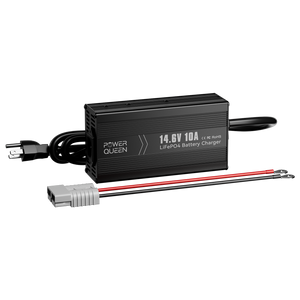
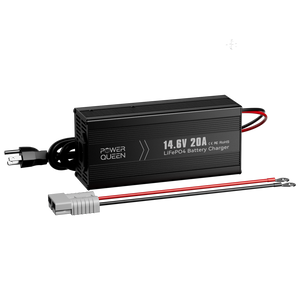
Not necessarily a “special” charger, but the charger should be properly sized for the battery capacity. A common lead-acid guideline is charging at 10–20% of Ah rating. For example, a 100Ah battery often pairs well with a 10–20A charger. Always follow manufacturer specs.
Is the extra weight of a Group 31 battery worth the capacity gain?
Often yes when you need longer runtime—assuming your vehicle/system can handle the added weight. For weight-sensitive setups, consider Group 27 or a lithium upgrade.
Which battery group is better for a 12V trolling motor?
It depends on runtime needs and space. Group 27 is fine for shorter trips, while Group 31 typically offers longer runtime for all-day use.
Conclusion
Choosing between Group 27 and Group 31 depends on power requirements, available space, weight limits, and budget. Group 31 usually provides more capacity and higher CCA, while Group 27 is more compact. If you want major gains in usable capacity and weight savings, consider LiFePO4 lithium Batteries in either size.